Solar and Wind Energy Hybrid Renewable System
ABSTRACT
Solar and Wind Energy Hybrid Renewable Systems are the ideal Affordable and Clean Energy solution for generating electricity and economic growth in rural Africa.
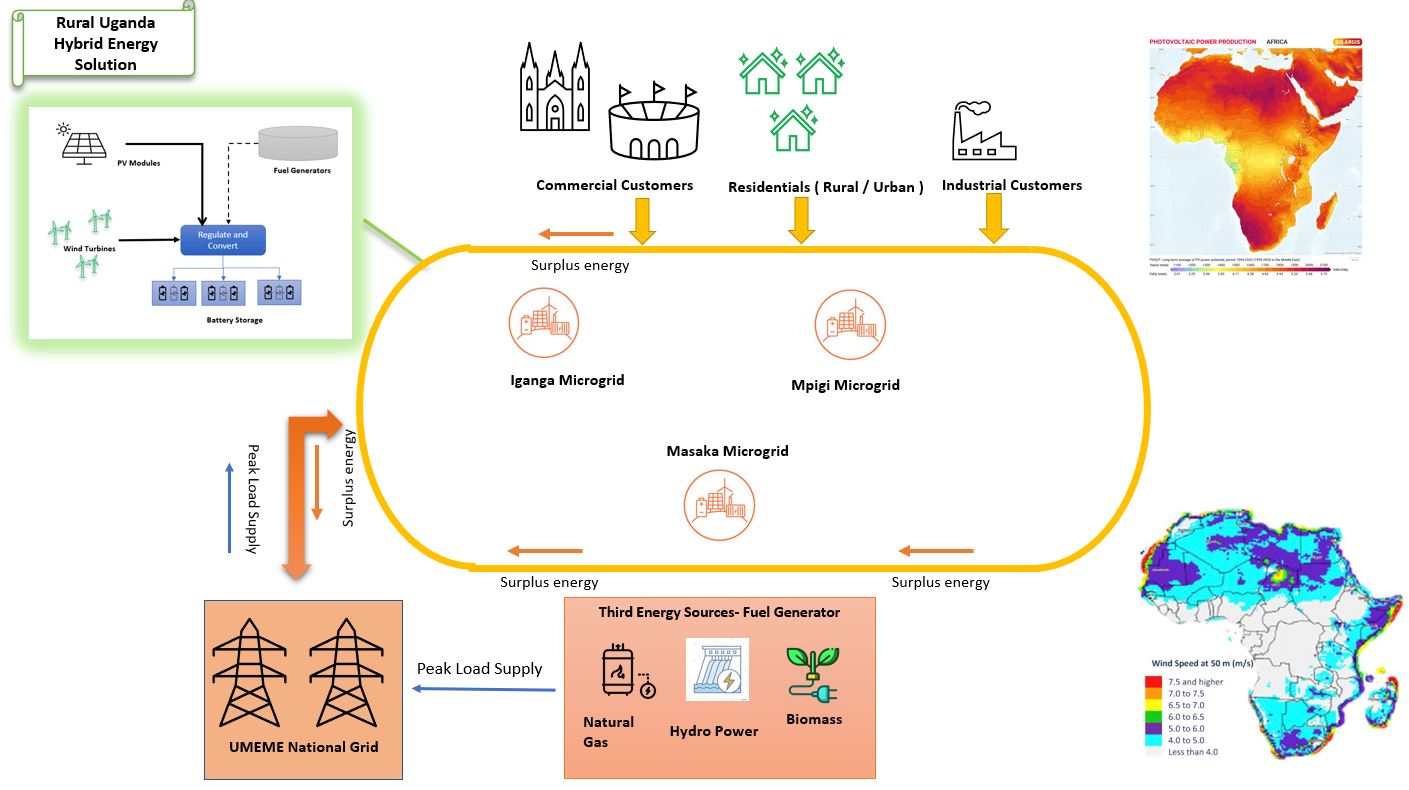
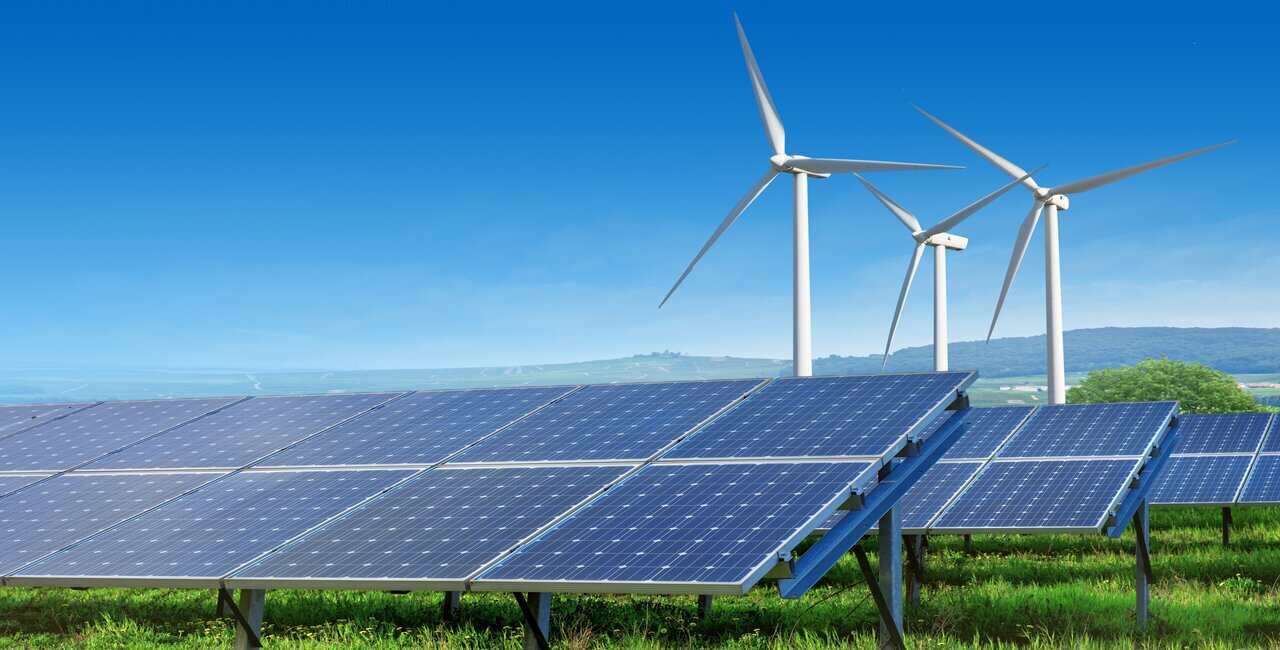
As shown in the diagram, fields of solar panels can bring great masses of energy to Africa’s most rural areas. Africa is often considered and referred to as the "Sun continent," the continent where the Sun's influence is the greatest. According to the "World Sunshine Map," Africa receives many more hours of bright sunshine during the course of the year than any other continent. With 25% of Africa covered in desert, solar irradiance is considered to have the most potential in providing any African location with electricity. Some areas receive up to 2000 kWh/m²/year of direct sunlight.
Winds across Africa offer another renewable energy potential of 180,000 tWH per year. Wind Turbines, as shown in the diagram, are placed in plains to harness the most amount of energy possible. One turbine can produce 6 million kWH each year with average wind speeds of 7.5 meters per second. This technology is becoming ever more affordable; for example, in the United States, the cost of wind energy has decreased from over 55 cents (current dollars) in 1980 to an average of under 3 cents per kWh today. To ensure future industry growth, wind technology must further improve reliability, increase capacity factors, and move to offshore wind production.
Together, solar and wind energy combine to create a hybrid system along with other components such as generators, battery storage, and microgrids. These intermittent sources will not only encourage efficiency and durability in these energy systems, together they weaken the severity of climate change.
Battery storage is most appropriate when surplus energy is introduced. When there are low levels of wind or sunlight, electricity stored on the battery can be used as a backup. Alternatively, when the system is producing more energy then, the surplus will be stored. This surplus energy can be sold back to the national grid from the microgrid. When coupled with energy co-operatives, it provides a platform for revenue generation. With almost 70% of Africa’s population concentrated within and around the Sahara, this is a huge potential for micro-grids to aid vast communities in becoming less dependent on traditional fuels for power and economically independent. This is an example of how technology created by electrical and chemical engineers can have a social impact.
It’s important we consider the ideas and concepts entailed from within Africa’s population as the popularity of this invention spreads. Once this solution is introduced to Africa, renovations to the solution and new job opportunities will be generated. In due time, the solution will advance as companies and businesses compete for success. Every year, 13 million people look for a job in Africa. According to Mugo Kibati and Gilles Vermot Desroches, “...one industry is poised to fill the jobs gap: the renewable energy industry.'' The industry can potentially commit to the emergence of one-fifth of African Employment Growth.
One of the most acute constraints is the expense of hybrid systems. These costs can be mitigated by funding from organizations such as AREI (Africa Renewable Energy Initiative) and SeForAll (Sustainable Energy for All).
Responsible resource usage is an essential component for Africa as solar and wind energy sources will be limited at times. If there isn't enough energy provided from battery storage, a third energy source is needed, a generator. Using a mainstream Fossil Fuel based generator is a reliable and responsible use of sources.
Although investment in renewable sources has been contributed, over 600 million people in Sub-Saharan Africa continue to lack electricity. Hybrid Renewable Systems are vital to electricity funds for Africa. There may be global benefits to this technology, extending from reducing poverty and greenhouse gas emissions. This technology will steer Africa’s present, and future.
Winds across Africa offer another renewable energy potential of 180,000 tWH per year. Wind Turbines, as shown in the diagram, are placed in plains to harness the most amount of energy possible. One turbine can produce 6 million kWH each year with average wind speeds of 7.5 meters per second. This technology is becoming ever more affordable; for example, in the United States, the cost of wind energy has decreased from over 55 cents (current dollars) in 1980 to an average of under 3 cents per kWh today. To ensure future industry growth, wind technology must further improve reliability, increase capacity factors, and move to offshore wind production.
Together, solar and wind energy combine to create a hybrid system along with other components such as generators, battery storage, and microgrids. These intermittent sources will not only encourage efficiency and durability in these energy systems, together they weaken the severity of climate change.
Battery storage is most appropriate when surplus energy is introduced. When there are low levels of wind or sunlight, electricity stored on the battery can be used as a backup. Alternatively, when the system is producing more energy then, the surplus will be stored. This surplus energy can be sold back to the national grid from the microgrid. When coupled with energy co-operatives, it provides a platform for revenue generation. With almost 70% of Africa’s population concentrated within and around the Sahara, this is a huge potential for micro-grids to aid vast communities in becoming less dependent on traditional fuels for power and economically independent. This is an example of how technology created by electrical and chemical engineers can have a social impact.
It’s important we consider the ideas and concepts entailed from within Africa’s population as the popularity of this invention spreads. Once this solution is introduced to Africa, renovations to the solution and new job opportunities will be generated. In due time, the solution will advance as companies and businesses compete for success. Every year, 13 million people look for a job in Africa. According to Mugo Kibati and Gilles Vermot Desroches, “...one industry is poised to fill the jobs gap: the renewable energy industry.'' The industry can potentially commit to the emergence of one-fifth of African Employment Growth.
One of the most acute constraints is the expense of hybrid systems. These costs can be mitigated by funding from organizations such as AREI (Africa Renewable Energy Initiative) and SeForAll (Sustainable Energy for All).
Responsible resource usage is an essential component for Africa as solar and wind energy sources will be limited at times. If there isn't enough energy provided from battery storage, a third energy source is needed, a generator. Using a mainstream Fossil Fuel based generator is a reliable and responsible use of sources.
Although investment in renewable sources has been contributed, over 600 million people in Sub-Saharan Africa continue to lack electricity. Hybrid Renewable Systems are vital to electricity funds for Africa. There may be global benefits to this technology, extending from reducing poverty and greenhouse gas emissions. This technology will steer Africa’s present, and future.